Key takeaways
- The payment itself is only a few seconds faster – the big time saving happens behind the bar: no change, no late-night counting, no bank runs.
- According to the Bundesbank, a cash payment costs German retailers 43 cents on average – festivals add cash logistics and peak loads on top.
- Vendors and organisers report 15 to 30% higher spend per head – none of it independently verified.
- In Germany, leftover credit must be refunded without a fee – don't count on it as extra income.
- Don't ban cash, concentrate it: cash top-ups at a few registers, nothing but taps at the bar.
How much time does cash cost at the register?
The best data on payment times doesn't come from the events industry but from retail: Germany's central bank, the Bundesbank, worked with the pollster forsa to time more than 10,000 payments – from stating the amount to handing over the receipt or change (Bundesbank, January 2023).
| Payment method | Average time |
|---|---|
| Smartphone or smartwatch | 14.0 s |
| Contactless card, no PIN | 15.2 s |
| Cash (all amounts) | 18.7 s |
| Contactless card with PIN or signature | 23.3 s |
| Inserted card | 25.7 s |
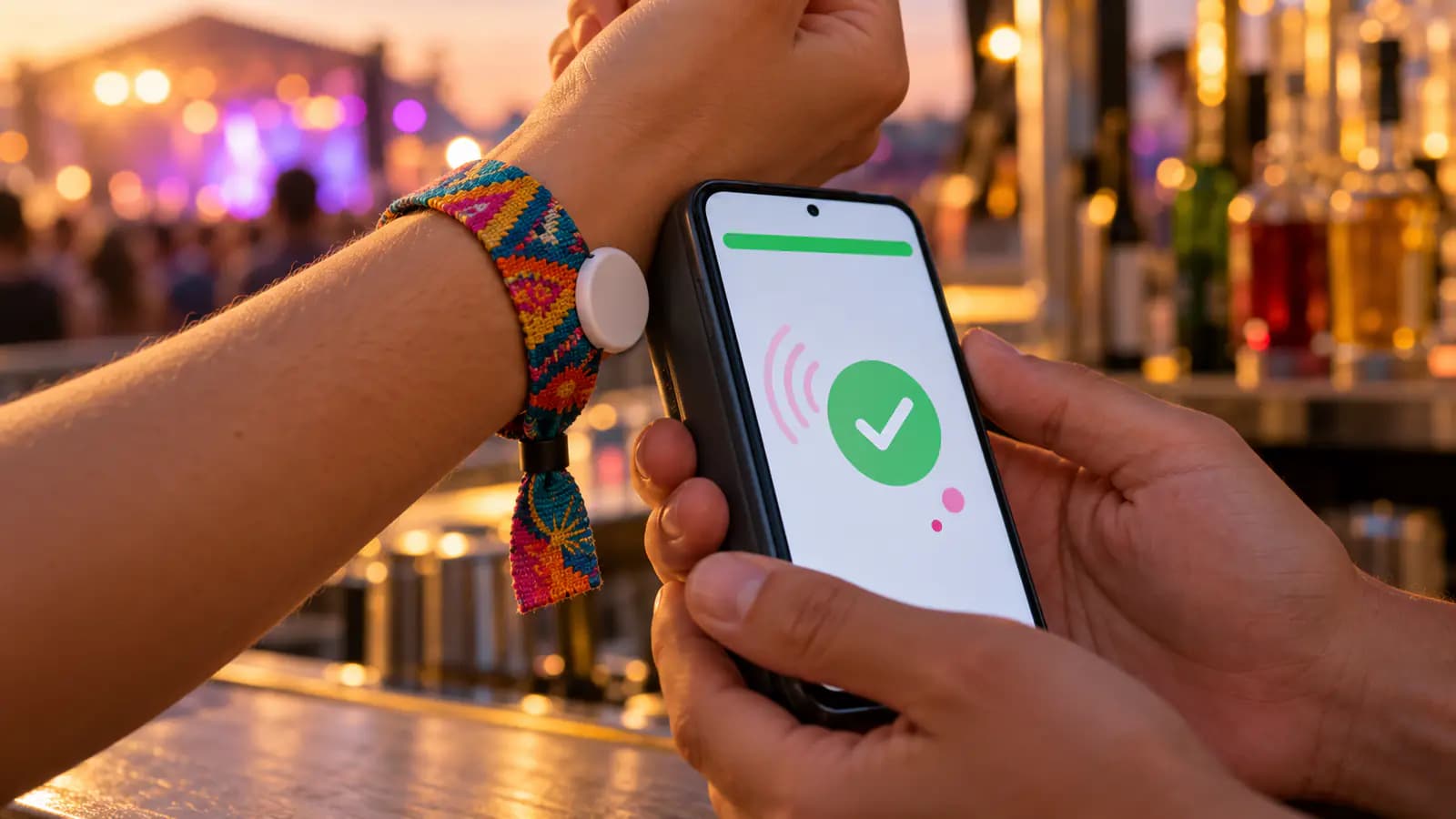
To be honest, the difference per payment is smaller than many vendors promise. According to the Bundesbank, cash payments under €10 take 15.2 seconds on average – exactly as long as a contactless card without a PIN. A wristband tap needs no PIN, no receipt and no change, so it sits at the fast end of the table. Still, expect a few seconds per payment, not minutes. You'll find claims like "up to 60% faster" on vendor websites, usually without any methodology.
The bigger time sink is behind the bar. Cash creates work no guest ever sees:
- Change floats – ordering coins and notes, stocking every register and topping them up at peak times.
- Register handovers at every shift change – counting, signing off, logging.
- The cash-up after closing, often with two people and often deep into the night.
- Chasing discrepancies when the drawer and the receipts don't match.
- Storing and moving the money: a safe, a cash office, trips to the bank or a cash-in-transit service.
With cashless payments, every sale is recorded the moment it happens. The shift report shrinks to a look at the numbers – counting is only needed where guests top up with cash.
What does cash really cost?
Again, the Bundesbank has the most solid figure: a cash payment costs retailers 43 cents on average (Bundesbank, November 2025). That includes fees, device and transport costs, but also the time staff spend handling cash at the till and in the back office. Germany's girocard debit card costs just under 1% of turnover. To be fair: per payment, cash is the cheapest method in German retail.
But a festival isn't a supermarket. Registers exist for one weekend, there's no established cash logistics, and a bar handles hundreds of payments an hour. What is routine in retail becomes a project on site – and the prices for it are rising. One German retailer reports that its cash-in-transit provider raised the price per collection from €49.99 to €54.31, and in the same example the bank charges up to 50 cents per coin roll (Lebensmittel Praxis).
| Cost block | What's behind it | With cashless |
|---|---|---|
| Change | Ordering coin rolls and notes, stocking registers | gone at the bar, stays at top-up registers |
| Counting & cash-up | Shift handovers, end-of-night count, discrepancies | largely gone |
| Transport & deposits | Cash-in-transit or own trips, bank fees | much lower |
| Security | Safe, cash office, escorts | much lower |
| Errors & shrinkage | Wrong change, shortfalls, theft | lower, but not zero |
There are no reliable figures on shrinkage at festival bars. What is clear: every payment that doesn't go through the cash drawer ends up in your sales report automatically and traceably.
Higher spend per head: what the numbers say
The most cited argument for going cashless is higher spend per guest. The figures almost always come from vendors or organisers themselves:
- Standon Calling (UK, 17,000 capacity): bar spend per head up 24% in its first cashless year, and up another 15% in a later year. 79% of surveyed guests felt queues at bars and food stalls moved faster (Festival Insights).
- Intellitix (cashless vendor): 15 to 30% higher per-capita spending according to its own study – with no published methodology (Intellitix).
- Open Air St. Gallen (Switzerland): cashless since 2013, sales have risen since – no exact figure (HSG Executive School).
Read these numbers with care. The comparisons use different baselines – the previous year, card payers, other events – and line-up, weather or price changes aren't factored out. There is no independent, controlled study for festivals.
The effect is still plausible: shorter queues mean more rounds at peak time, nobody stands at the bar with an empty wallet, and spending a preloaded balance feels less like spending money than handing over a note. Treat an uplift as an upside – not as a fixed line in your budget.
Worked example: a cashless festival with 5,000 guests
What does this mean for a real event? The calculation below uses assumed values for one festival day – swap in your own numbers. Only the time and cost per payment come from the sources above.
| Assumption | Value |
|---|---|
| Guests per day | 5,000 |
| Bar and food purchases per guest | 4 |
| Payments per day | 20,000 |
| Food & beverage spend per guest | €30 |
| Time saved per payment (cash vs. contactless without PIN) | 3.5 s |
| Result | Calculation | Value |
|---|---|---|
| Time saved at the point of payment | 20,000 × 3.5 s | about 19.4 hours |
| Cash cost, using the retail benchmark | 20,000 × 43 cents | about €8,600 |
| Uplift at +15% (low end of vendor figures) | €150,000 × 15% | €22,500 in revenue |
The 19.4 hours are spread across all registers: with ten registers that's almost two hours per register per day – right at peak times, when queues would otherwise build up. On top of that comes the time behind the bar for floats, handovers and the cash-up, which can't be put into a single number.
The €8,600 is not money you simply save. The Bundesbank figure comes from retail, and cashless has costs of its own – more on that in the next section. And the €22,500 is revenue, not profit: cost of goods and staff still come off. How to fit items like these into your overall budget is covered in our article How Much Does a Festival Cost?.
The other side: what does cashless cost?
An honest calculation needs both sides. These are the costs that come with going cashless:
- Wristbands or chips for every guest – often handed out at the entrance together with the ticket.
- Devices for the registers – rented terminals or your own smartphones and tablets.
- Payment fees on card and online top-ups.
- Internet at every register – test it on site beforehand, especially for peak times.
- An info or cashless desk for questions, lost wristbands and payouts.
- Training for the bar team and volunteers.
- Paying out leftover credit – staff time, cash or bank transfers.
Public price lists for wristbands, terminal hire or vendor commissions are rare, and offers vary widely. Get several quotes and break everything down per guest – then you'll see whether the savings cover the costs.
The biggest levers are usually the devices and any share of your revenue. With Alpha Events, the POS system runs on your own phones instead of rented terminals: for NFC payments you need an Android phone or tablet with NFC and Chrome, for cash and card any smartphone will do – cards are taken via a SumUp terminal or the SumUp app. Online top-ups go through your own Stripe account, and Stripe bills the payment fees to you directly. Important: every register needs internet. Without a connection the register locks instead of losing payments.
Leftover credit and fees: the rules in Germany
Some organisers have counted on fees and unclaimed credit to make cashless pay. In Switzerland, 1 to 1.5% of balances aren't reclaimed within two years, according to the NZZ am Sonntag (via HSG Executive School). In Germany, that route is now largely closed.
On 28 January 2025, the Berlin Regional Court barred the organiser of Lollapalooza Berlin from charging €1.50 for card top-ups and €0.50 for refunding leftover credit; the short refund deadline was invalid too, and the regular three-year limitation period applies (case no. 52 O 98/24). According to the Federation of German Consumer Organisations (vzbv), the judgment is final (vzbv).
Since May 2025, the vzbv has sent formal warnings to ten festival organisers, eight of whom signed cease-and-desist declarations. It objected to activation and top-up fees of €0.29 to €2, refund fees, minimum refund amounts of €1 to €2.50 and refund windows of only a few weeks (vzbv, July 2025).
- No fee for card top-ups when the wristband is the only way to pay.
- Refund leftover credit in full – no fee and no minimum amount.
- Don't limit refunds to a few weeks.
- Communicate every cost around the wristband clearly.
Going cashless step by step
Festival, open air, concert or club night: the path to cashless looks much the same everywhere. Here's how to approach it:
- 1Gather your numbers: food and beverage revenue, number of registers, peak times and last year's cash-handling costs.
- 2Choose a model: wristband as the only way to pay, or mixed – card and wristband at the bar, cash only at top-up registers.
- 3Plan wristbands and devices: order chips, decide on register devices, test the internet at every register spot.
- 4Define top-ups and payouts: online in advance, cash and card on site, payouts without a fee.
- 5Brief your team and staff an info desk for questions and lost wristbands.
- 6Tell your guests: in the ticket shop, in your newsletter and in the visitor app – how to top up, how to get credit back.
- 7Review: compare revenue per register and per hour with last year – that's how you see what cashless really delivered.
How NFC wristbands, registers and top-ups work in detail is explained in our guide Cashless at Festivals. What Alpha Events brings to the table is on the Cashless page.
Conclusion: how much time and money does cashless save?
There's no one-size-fits-all number – but there is an honest rule of thumb. Based on the Bundesbank figures: for every 1,000 payments you save almost an hour of pure checkout time (1,000 × 3.5 s) and avoid up to €430 in cash-handling costs (1,000 × 43 cents, a retail benchmark). For the example festival with 5,000 guests, that's about 19.4 hours and up to €8,600 per day – before the cost of wristbands, devices and fees comes off.
| Area | What cashless saves | How reliable? |
|---|---|---|
| Time at the point of payment | about 3.5 s per payment – about 19.4 hours per day in the example | measured (Bundesbank, retail) |
| Time behind the bar | floats, shift handovers, the cash-up and bank runs disappear at the bar | can't be put into one number |
| Cash-handling costs | up to 43 cents per payment – up to €8,600 per day in the example, minus the cost of cashless | retail benchmark |
| Revenue | +15 to 30% per head according to vendors – €22,500 extra revenue at +15% in the example | not independently verified |
| Fees & leftover credit | no extra income – refunds without a fee | case law, get advice |
The most reliable saving is time and effort around cash – above all at peak times at the bar and when cashing up after closing. Higher spend is an upside on top, not a fixed line item. Because the savings grow with every payment while the costs mostly arise per guest, cashless pays off more the more your guests buy on site. Run the worked example with your own numbers – then you'll know what cashless brings to your event.
Put it into practice with Alpha Events
The matching tools – in one platform, free to try.