Key takeaways
- Extreme weather is no longer a one-off: in June 2026 alone, several festivals in Germany were paused or cancelled because of heat or thunderstorms.
- According to Germany's weather service, heat is measurably increasing – plan water, shade and timing as firmly as stage and power.
- Set thresholds and a chain of command before the season – debating in the middle of a storm costs time.
- Communicate early and explain why – from the stage, on screens, in the app and on social media, including people still travelling in.
- Cover the remaining risk: a weather reserve in the budget, the right insurance and a clear refund process.
Festival summer 2026: what the weather cancelled
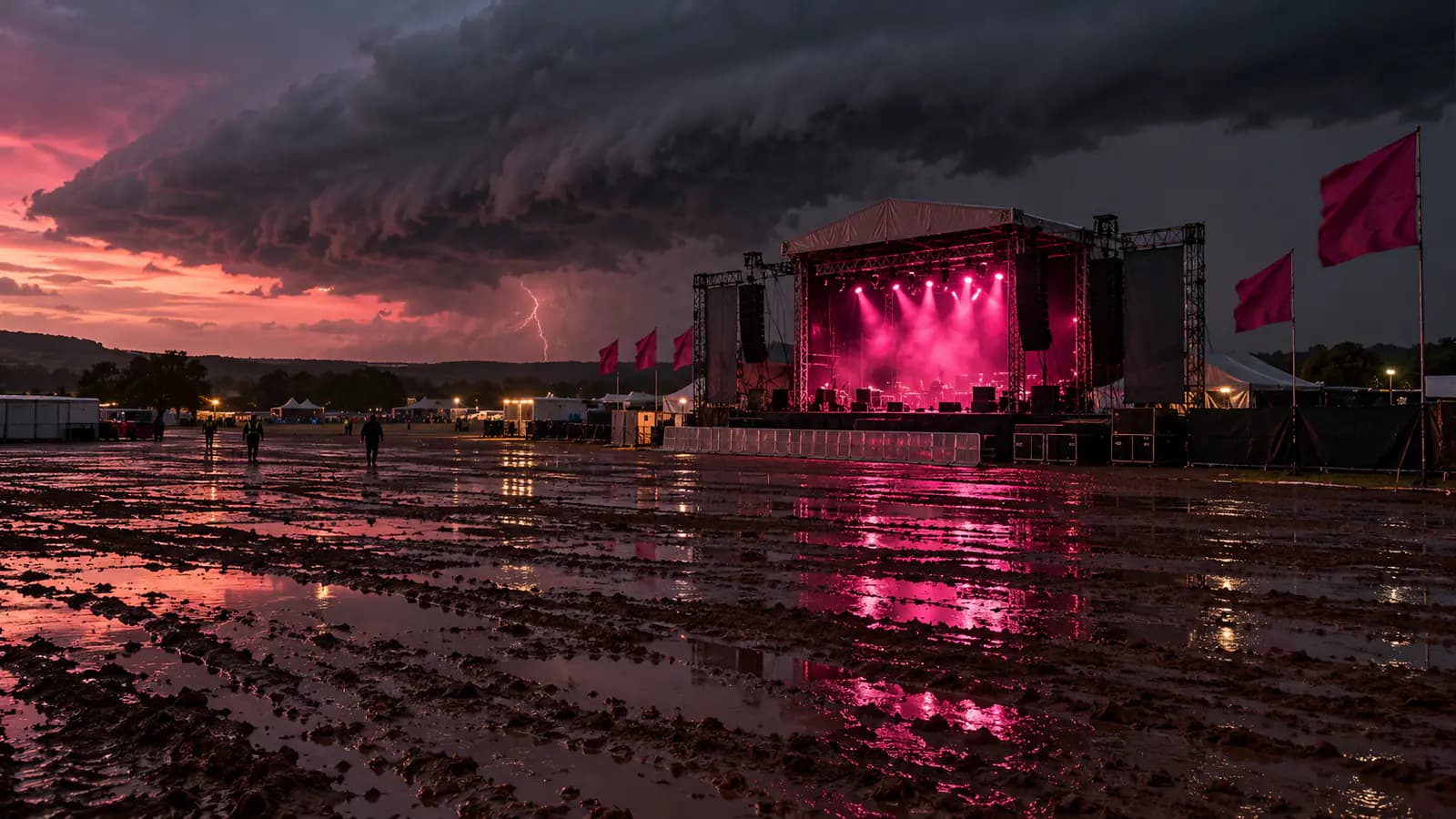
In late June 2026 a heatwave with forecasts of 36 to 39 °C hit right in peak season, with thunderstorm fronts in between. For many promoters that meant pausing the show, clearing the site or cancelling altogether. A selection:
| Festival | What happened | Trigger |
|---|---|---|
| Southside, Neuhausen ob Eck (19 June) | site fully cleared, fans told to shelter in their cars; after almost two hours the show resumed at 10 pm, several sets were not rescheduled | official severe weather warning after a hot day |
| Electronic Wine Festival, Koblenz (Friday, 19 June) | site at the Deutsches Eck cleared, decided in advance by a coordination group with the authorities | forecast thunderstorm cell |
| Festival south of Flensburg (night to 20 June) | around 5,000 guests evacuated overnight, 13 minor injuries | severe storm |
| Fusion Festival, Lärz (25 June) | stopped for around two hours, tens of thousands evacuated onto the runway of the former airfield, then the show resumed | fires outside the grounds during the heatwave, cause unclear according to police |
| Sunset Beach Festival, Halterner Stausee, + a Jan Delay concert | cancelled at short notice, around 24,000 guests expected, full ticket refunds | extreme heat |
| Vainstream, Münster (27 June) | stopped before the headliners “on official and meteorological advice” | lightning risk |
Next door it got serious too: the Dutch weather service issued its first-ever code red for heat, and the hardstyle festival Defqon.1 was called off with the site fully built.
The problem itself isn't new. In 2016 lightning struck at Rock am Ring, the state government counted 82 injured, and the local council withdrew the permit for the final day. The same year Southside was cancelled after a storm. In 2023 Wacken had to stop admissions for the first time since 1990 after days of rain. What's new is how often it happens – and that heat is now as much a reason to cancel as thunderstorms.
Climate change: what it means for open airs in Germany
In 2025 Germany's national weather service DWD summed up the research in a fact sheet on extreme weather. The key findings for promoters: Germany has warmed by around 2.5 °C since 1881 – twice the global average. Days above 30 °C have quadrupled since the 1950s, and heatwaves are more frequent and more intense.
And the trend continues: according to DWD projections reported by epd in March 2026, southern and eastern Germany will warm the most, with the biggest changes in summer – right in festival season.
- Heat is the clearest risk. More circulatory problems, more medical call-outs, higher water demand, exhausted crews.
- Thunderstorms after hot spells often hit open airs in the evening, when the site is at its fullest – as at Southside.
- Heavy rain is harder to pin down: DWD sees signs of an increase, especially in southern Germany, but the records are still too short for a clear trend.
- Drought raises the fire risk on meadows, car parks and campsites.
What extreme weather costs a festival
Many festivals run on thin margins. According to the festival study by the German Music Information Centre, Germany has around 1,800 music festivals; almost half break even with neither profit nor loss, and about ten percent see their future at risk. One lost day can be enough to tip the balance.
2016 shows how big the damage can get: after the storms at Hurricane and Southside, promoter FKP Scorpio spoke of losses in the tens of millions of euros. And costs don't only arise when a show is stopped – prevention costs money too:
| Risk | Typical extra costs | When they hit |
|---|---|---|
| Heat | drinking-water points, shade sails and tents, more medics, cooling for bars and crew | before and during the event |
| Heavy rain | ground protection and tracks, drainage, wood chips, towing for car parks | during and after the event |
| Storms and lightning | ballast, wind monitoring, shelters, waiting time with a fully staffed crew | during the event |
| Stopping or cancelling | refunds, lost bar and food revenue, artist fees depending on contract, take-down with no income | afterwards |
Event cancellation insurance often covers weather only as a separate add-on, and premiums quickly become too high for smaller festivals. An alternative is parametric weather insurance: it pays out as soon as an agreed weather station measures a value above a threshold – rainfall or temperature, say – with no loss adjuster involved. First providers in Germany plan to offer such policies for open-air events as well.
Emergency planning: the severe weather plan before the season
At Vainstream the first warning went out at 6 pm and the show was stopped about 90 minutes later. At Southside the public warning app NINA sounded just before 8 pm – and fans knew where to go: their cars. Procedures like that only work if they are agreed in advance – weather risk management for events is mostly about making the calls before you need them. Your severe weather plan should cover:
- 1Warning sources: official DWD warnings, a warning app, a lightning detection service – and for larger events a meteorologist on call or on site.
- 2Thresholds: for events, Germany's electrical standards body VDE recommends an alert zone of at least 10 km around the site. For wind, the limits in the inspection book and operating manual of each stage and tent apply – measured as gusts, not mean wind speed.
- 3Levels: advance warning → pause → evacuation → stop, each with a trigger, an action and a path back to the all-clear.
- 4Decision makers: who decides alone, and who decides together with the authorities, police and security? Put it in writing in your safety plan.
- 5Shelter: where do thousands of people go within ten minutes? Halls, suitable tents, vehicles – and what about guests without a car?
- 6Announcements: ready-made scripts for every level, in German and English, for the MC, screens, app and social media.
- 7Storm run sheet: who clears which area, who opens which gates, who staffs the emergency exits? Assign it per area and shift, not per person – the crew on duty at 7.30 pm isn’t the one from midday.
The YOUROPE Weather Toolbox points out a trap: the strongest gusts often arrive with the first gust front, before the storm itself is overhead. If you wait for the rain, you're too late. How your severe weather plan fits into the rest of your planning is covered in our article on the event safety plan.
Heat: water, shade and a different schedule
Heat arrives more slowly than a storm, but it affects everyone – guests, crew and artists. Vainstream kept going through record heat with free water points, shade and cooling; at the front, security threw water bottles into the crowd. What helps when you plan:
- Free drinking-water points at stages, campsite and entrance – enough that nobody queues in the sun.
- Shade from sails, tents and trees; don't forget the queueing areas at the gate.
- Adjust the timetable: put the peaks in the evening, calmer acts or breaks at midday.
- Supply the front rows: bring water to the area in front of the stage that nobody can leave quickly.
- Protect your crew: shorter shifts in the sun, drinks and breaks for security and volunteers, build-up in the early morning.
- Add medical cover: heat raises the number of call-outs – agree on it early with your medical provider.
How much water you need and where, you can work out in advance in the Alpha Events site planner: drop drinking-water stations, bars and toilets onto the map, connect them and see whether pressure and flow are enough. It doesn't replace a qualified installer, but it shows you early where lines are missing. Shorter shifts for hot days are planned in the shift planner.
Weather alerts and crisis management: reaching guests in minutes
At Vainstream the storm warning went out via the app and social media, and people still on their way were asked to delay their journey. That's the point: good communication doesn't just reach the crowd in front of the stage, but also people at the campsite, on the shuttle and on the motorway.
- On site: announcements from the stage, text on every screen, megaphones for the crew.
- On phones: a push notification from the festival app, posts on social media and messenger channels.
- For people travelling in: a clear message on whether to wait, turn back or keep going.
- For the team: radio as the backbone – full sites overload mobile networks quickly.
Budgeting for weather risk: refunds and a financial buffer
Whether and how much you refund depends on whether you cancel before the start or stop midway, on your ticket terms and on the reason. The promoters in Haltern refunded the full ticket price; at Southside in 2016 fans got most of it back. These questions are legally tricky – get advice before you write your terms for next season.
- 1Document the decision: warnings, agreements with the authorities, times – you'll need them for insurance and questions later.
- 2Inform everyone: guests, artists, suppliers and crew – with a timeline for further updates.
- 3Explain refunds: when, how and for what? Think about cup deposits and bar credit too – at Vainstream guests couldn't return their cups after the show was stopped.
- 4Record the costs: which invoices will still arrive, what does insurance cover, what stays with you?
Build weather into your budget from day one: separate line items for water, shade and ground protection, plus a reserve for losses. How to set a sensible contingency is covered in our article on event budget planning, and how to finance a festival overall in festival costs and financing. In the Alpha Events budget planner every invoice is assigned to its line item – so after the season you can see in black and white what the weather cost you.
Looking ahead: how festivals adapt for the long term
No festival can change the weather, but every festival can become more resilient. From the experience of summer 2026, a few directions emerge – as an assessment, not a certainty:
- Choose sites with climate in mind: trees, hard tracks, good drainage and a hall nearby matter more than the prettiest view.
- Review your dates: if you're planning a new event, weigh whether avoiding the hottest weeks lowers the heat risk – though storms happen in May and September too.
- Plan fallback stages: tents or halls where parts of the programme can move.
- Flexible contracts: weather clauses with artists and suppliers, for example for replacement dates or partial payments.
- Collect data: log temperatures, water use, medical call-outs and downtime – next year you plan with real numbers instead of gut feeling.
- Learn from each other: networks like YOUROPE share guidance on weather and safety; talking to other promoters saves costly mistakes.
Festivals will keep happening under open skies – that's their appeal. If you treat heat and storms as a fixed part of planning rather than bad luck, you'll get through next summer safer and cheaper. Our festival planning checklist helps you keep track of every task.
Put it into practice with Alpha Events
The matching tools – in one platform, free to try.