Key takeaways
- Authorities ask for an event safety plan when the size or type of event calls for it – in Germany the rules are state law and differ from state to state.
- Talk to the public order office, fire brigade, police and medical service early – some cities want the plan months before the date.
- Security firms need a licence under § 34a GewO; first-aid cover and fire watch come from relief organisations and the fire brigade.
- An emergency and evacuation plan only works if everyone knows it – briefings and clear responsibilities are part of it.
- Keeping the site plan, staffing plan and tasks in one place saves you a pile of paper on show day.
What is an event safety plan – and when do you need one?
An event safety plan is a written document that sets out how an event runs safely for audience, crew and artists: which hazards exist, what you do about them and who decides what in an emergency. It is the core of event safety and security – and the basis on which the authorities, fire brigade and police assess your event.
There is no single national rule in Germany. What counts are the places-of-assembly regulations of the federal states, based on the model regulation (Muster-Versammlungsstättenverordnung, MVStättVO). The model applies to rooms for more than 200 visitors, to open-air sites with performance areas and stands for more than 1,000 visitors unless they are temporary structures, and to stadiums with more than 5,000 places. A safety plan is required when the type of event calls for it – above 5,000 visitor places it must be agreed with police, fire brigade and ambulance service (§ 43, Bavarian example).
| Situation | Typical rule* |
|---|---|
| Club or hall, rooms for more than 200 visitors | the state's places-of-assembly regulation applies |
| Hall or arena with more than 5,000 visitor places | safety plan agreed with police, fire brigade and ambulance service |
| Festival or open air on an open field | often outside the regulation – the public order office asks for a plan based on size and risk |
| Smaller event with special risks (pyro, narrow paths, heavy drinking) | the authority can still ask for a safety plan |
This matters most for an open-air safety plan: a festival in a field without permanent stands usually falls outside the places-of-assembly regulation. General public order law and state guidelines apply instead, such as the guidance framework of the North Rhine-Westphalia interior ministry. In practice, the public order office almost always asks for a festival safety plan for larger open airs.
Getting your event approved: permits and conditions
There is rarely one single festival permit. Usually the public order office (Ordnungsamt) of your town is the first point of contact and brings in the other departments. In Bavaria, for example, public entertainment has to be notified at least one week in advance; outside venues designed for it, more than 1,000 visitors at once need a permit. Depending on the event, further approvals come on top:
| Topic | Typically handled by | What to watch |
|---|---|---|
| Notification or permit for the event | public order office | notify early, attach the safety plan |
| Stages, tents, stands (temporary structures) | building control | type approval with inspection book, acceptance on site |
| Selling alcohol | public order or trade office | temporary licence under § 12 GastG (Hesse: § 6 HGastG), often at least two weeks' notice |
| Public streets and squares | traffic or highways office | special-use permit, traffic management if needed |
| Music after 10 pm | environmental or public order office | apply for an exception for rare events |
| Youth protection | public order office, youth office | attendance and alcohol rules under §§ 5 and 9 JuSchG |
| Music licensing | GEMA | register the event in advance |
Meetings and decisions turn into event conditions: a minimum number of stewards, a maximum capacity, fixed end times, noise limits, fence plans or a glass ban. Read every decision carefully – each condition needs an owner later on and belongs in your staffing and task plan.
How to write an event safety plan: structure and content
A good safety plan is not a form but a piece of planning you build step by step. Model outlines from the German states – such as the sample table of contents in the NRW guidance – almost always follow the same logic. To write an event safety plan, work through these points:
- 1Event description: type, date, times, programme, target audience, expected and maximum attendance.
- 2Site and site plan: areas, stages, bars, fences, entrances and exits, escape routes, access for fire brigade and ambulance, assembly points.
- 3Risk assessment: what can happen? Crowding, severe weather, fire, power or technical failure, medical emergencies, alcohol, troublemakers.
- 4Protection goals and measures: for each hazard, how you prevent or contain it – from entry checks to the storm rule.
- 5Organisation: event management, stewarding, medical cover, fire watch and event technology – with names, contact details and decision rights.
- 6Communication: radio channels, PA announcements, prepared scripts and a plan B without mobile networks.
- 7Emergency and evacuation plan: scenarios, alerting, clearing parts of the site or the whole site.
The site plan is what everyone looks at – authorities, fire brigade, security and crew. Draw it on a real map rather than as a sketch. In the Alpha Events site map you place stages, bars, toilets, safety symbols and fences straight onto satellite or street maps and share the plan as a view-only link – the fire brigade or authority needs no account.
For higher-risk events, the guidelines recommend a coordination group: organiser, public order office, fire brigade, police and medical service agree the plan together and meet before and during the event. That is also where you settle who has the final say in an emergency.
Fire safety and noise control: the most common conditions
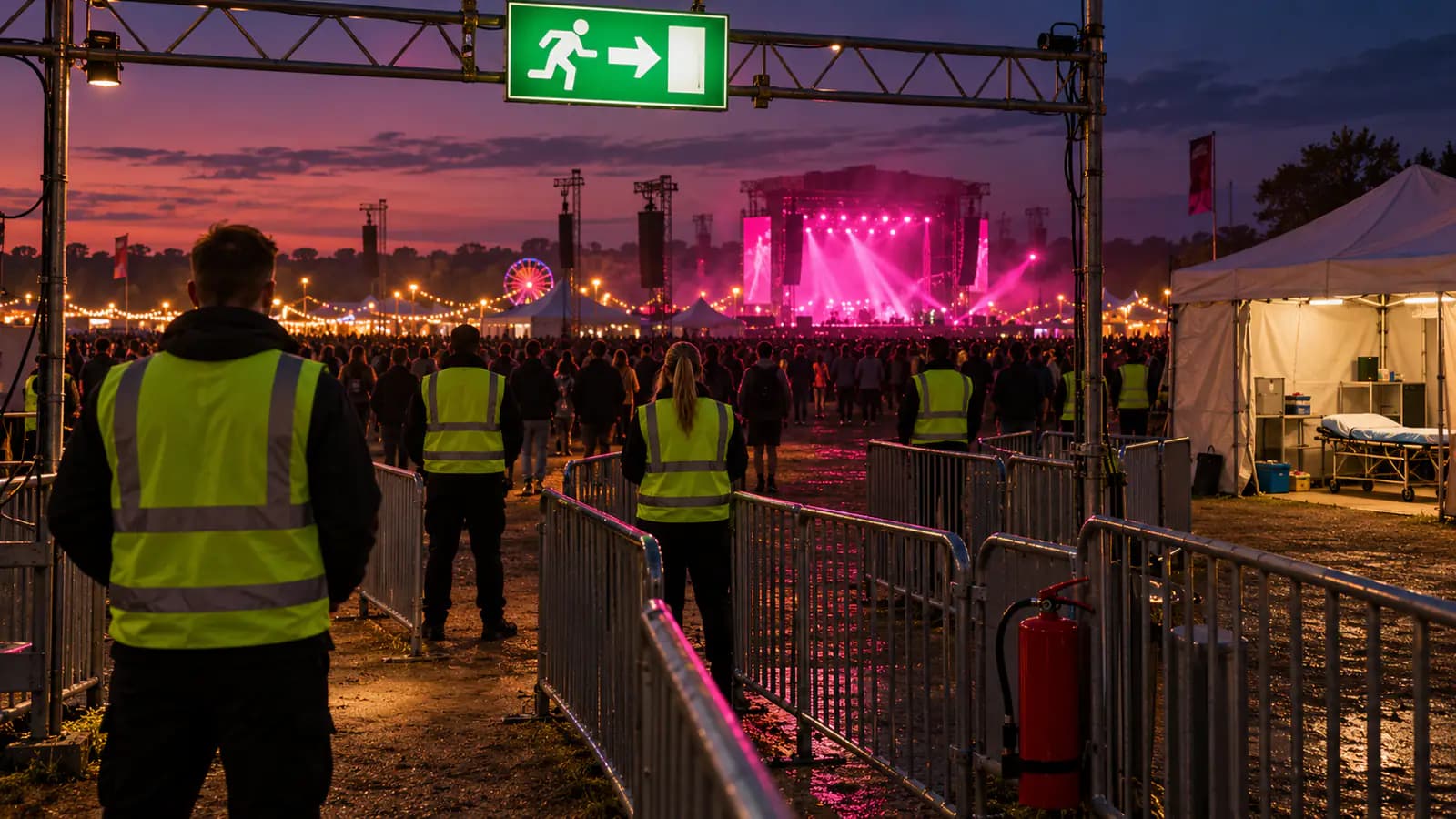
Fire safety at events means clear escape routes, marked emergency exits with safety lighting, extinguishers at stages, bars and food stalls, flame-retardant decoration and clear rules for pyrotechnics, gas and open flames. Places of assembly also need fire safety regulations and fire brigade plans agreed with the fire prevention office; staff are briefed when they start and at least once a year after that.
A fire watch (Brandsicherheitswache) is required whenever an event carries an increased fire risk – pyro, open flames or large stages. On large stages and performance areas over 200 m², the model regulation has the fire brigade provide it; your own staff only with the fire prevention office's approval. So you usually request the fire watch directly from the local fire brigade – and early.
Noise control at festivals is often where neighbours and authorities look hardest. The basis is the states' leisure noise guideline. For a general residential area, the German environment ministry lists 55 dB(A) until 8 pm, 50 dB(A) from 8 to 10 pm and 40 dB(A) at night – measured at the neighbour's, not in front of the stage. Rare events on a few days a year may be allowed higher levels: 70 dB(A) by day and 55 dB(A) at night.
For the audience itself there is the DIN 15905-5 standard: it sets 99 dB(A) as the limit and requires warnings and hearing protection at high levels. It is not a law, but ignoring it exposes you to liability.
- Point stages away from houses and fix end times in the timetable.
- Publish a phone number for residents – and answer it.
- Measure and log levels at front of house, offer earplugs at the entrance.
Emergency plan and evacuation plan
Writing an event emergency plan means making decisions in advance: what happens if a thunderstorm rolls in, the stage fails or it gets too tight in front of the stage? Who decides to pause or stop the show, who makes the announcement, who opens which gates? If safety-relevant systems fail, the operator has to stop the event – someone on site must be able to spot that and be allowed to act.
| Scenario | Trigger | First actions |
|---|---|---|
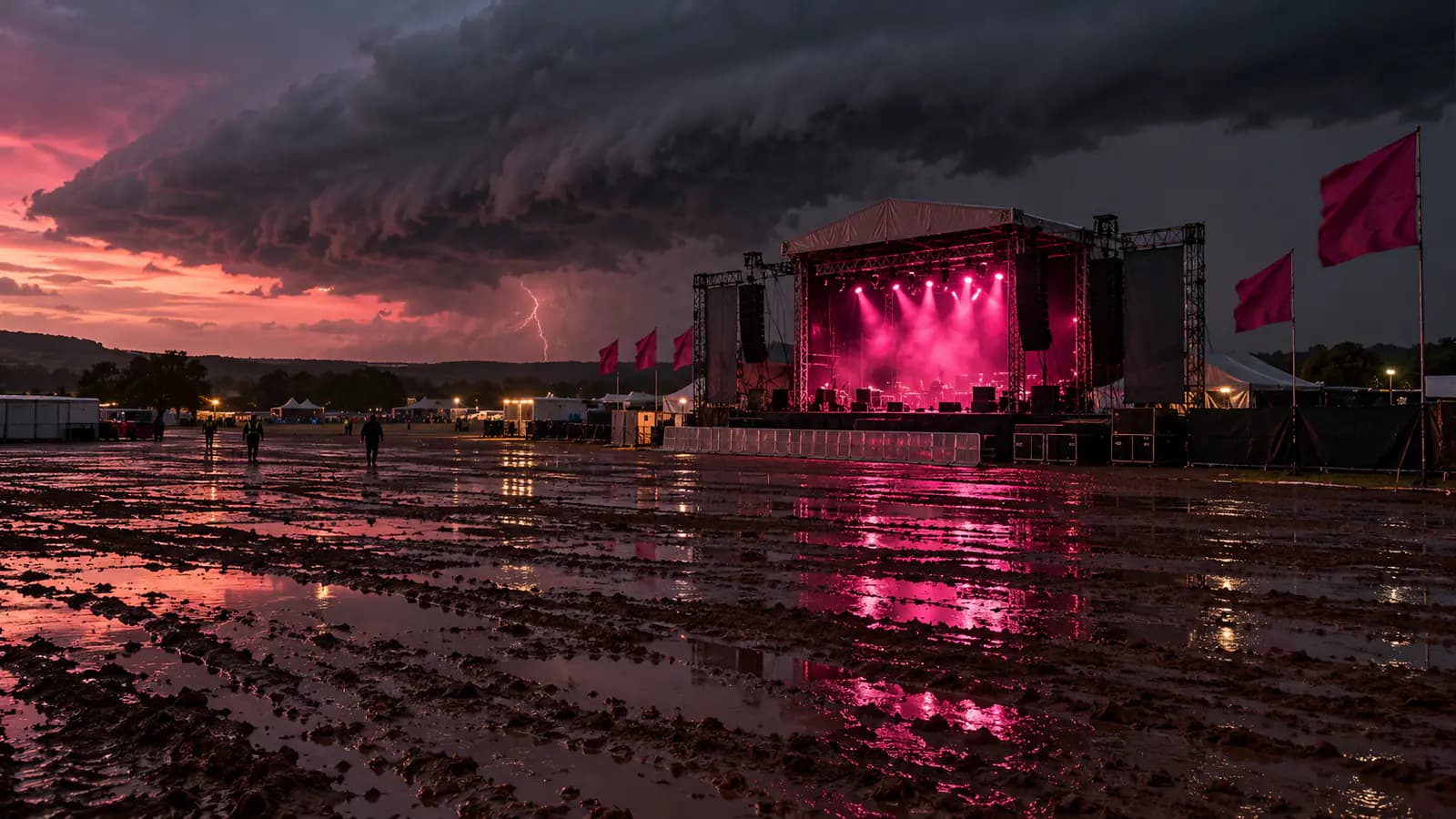
| Severe weather | weather warning, storm approaching | pause the show, announce, clear stages and tents, open shelters |
| Fire | smoke, fire alarm | alert the fire watch, clear the area, keep fire access free |
| Crowd crush risk | congestion at bottlenecks, density too high | stop inflow, pause the music, open relief areas |
| Power cut | stage or lighting goes dark | emergency lighting, radio and megaphone, keep calm |
| Medical emergency | radio call | guide medics to the spot, clear the way for the ambulance |
| Bomb threat | phone call, suspicious object | inform police, decision in the coordination group |
The evacuation plan describes how you clear single areas or the whole site in an orderly way: escape routes and their width, steward positions, announcement scripts, assembly points. For festivals it goes further – where do you take thousands of people if the site itself is unsafe, and how do you coordinate that with police and traffic? In some German states the evacuation concept is a separate document, in others part of the safety plan.
Security staff and specialists: who you need for what
When you hire an event security company, you buy professional protection – and professionals need a licence. Commercial security work in Germany requires a licence under § 34a GewO; every guard needs at least the chamber of commerce briefing course and must be registered in the national security register before working. Certain tasks, such as door control at clubs or lead roles at access-controlled large events, require the full competence exam.
| Role | Task | Who provides it |
|---|---|---|
| Security | entry and bag checks, stage pit, dealing with troublemakers | security company licensed under § 34a GewO |
| Stewards | guide visitors, keep escape routes clear, support evacuation | security company or briefed own staff – depending on the conditions |
| Head of stewarding | leads the stewards, contact for the authorities | experienced professional |
| Event medics | first aid, medical post, handover to the ambulance service | relief organisations such as the Red Cross (DRK), ASB, Johanniter, Malteser or private providers |
| Fire watch | fire safety during the event | fire brigade, own staff only with approval |
| Event technicians | run stage, lighting, sound and rigging safely | production companies – master or qualified technician depending on stage size |
Booking festival security: get several quotes and ask about the licence, liability insurance, experience with events your size and how many guards hold the competence exam. How many security staff a festival needs is ultimately set by the authority in its decision or the agreed plan. There is no national formula; some cities give guide values of one steward per 50 to 100 visitors for certain event types. If you need stewards for an event, ask your security company first whether it can provide them.
Booking event medics: medical services usually calculate the number of medics using the Maurer scheme or the Cologne algorithm – from attendance, type of event and risk factors such as weather or celebrity presence. Ask your local relief organisation early; capacity is tight in festival season.
Finding event technicians: on large stages the places-of-assembly regulations require persons responsible for event technology, such as a certified master. Under the model regulation, performance areas over 200 m² need one responsible person each for stage and lighting on site; for 50 to 200 m² a qualified event technician with three years' experience is enough.
Finding event staff: crew, helpers and volunteers
Besides the professionals, every event needs a crew: bar, cloakroom, ticket scanning, awareness, info point, build-up and take-down. Whether you post “festival volunteers wanted” or “festival crew wanted”, the best channels are usually your own: your event's newsletter and social media, local clubs and associations, universities, last year's crew and referrals from the team. That way you find event staff who already know your event.
- Event volunteers come for the experience and the community: offer festival access, food, a crew shirt and a proper briefing.
- Paid staff come through staffing agencies, job boards and student job services – clarify contract type, minimum wage and insurance.
- Security tasks such as bag checks or dealing with troublemakers are not for unqualified helpers – that is what the security company is for.
- Briefing for everyone: escape routes, assembly points, emergency call chain, radio and who to turn to with problems.
What matters is that commitments don't end up scattered across five group chats. When your crew applies for open shifts themselves, you see straight away where people are still missing.
Responsibilities and task allocation in the event team
The safety plan lists roles by name – but event responsibilities start long before show day. Who applies for the alcohol licence? Who books the fire watch? Who checks the stage's inspection book? A clear task allocation in the event team by area works well, each with one owner and a deputy:
| Area | Responsible for |
|---|---|
| Event management | overall responsibility, decision to pause or stop, contact with the authorities |
| Security | security company, stewarding, entrance, evacuation |
| Medical and fire safety | medical service, fire watch, extinguishers, escape routes |
| Technology | stage, power, lighting, sound, inspections |
| Crew and staffing | staffing plan, shifts, briefings, catering |
| Communication | announcements, social media, informing residents |
Many organisers start with a shift schedule template in Excel or a festival staffing plan template as a spreadsheet. That works until three people edit it at once, someone drops out or the authority asks for ten more stewards. A shift planner for events shows areas, shifts and gaps at a glance; with “Plan with AI” a short description turns into a draft with areas and open shifts that you review before anything is created. How to build a shift plan step by step is covered in our shift planning guide.
Everything that isn't a shift – applications, inspections, orders, conditions from the permit – belongs on a task board with owners, due dates and checklists. That way every condition has a name next to it and nobody assumes someone else is handling it.
Checklist: event safety plan and event organisation
Use this event safety checklist as a template for your event or open air. It does not replace official requirements, but it helps you forget nothing – and complements any checklist you use to organise a festival or event.
- Contacted the responsible authority, noted deadlines and required documents
- Set expected and maximum attendance, calculated areas
- Drew a site plan with escape routes, emergency exits, access roads and assembly points
- Wrote the risk assessment and measures per scenario
- Applied for permits: event, temporary structures, alcohol licence, special use, noise
- Booked a security company licensed under § 34a GewO, named the head of stewarding and the number of stewards
- Requested and confirmed medical cover and fire watch
- Named the persons responsible for event technology
- Agreed the emergency plan, evacuation plan and announcement scripts
- Sorted the radio plan and communication without mobile networks
- Filled every shift in the staffing plan, scheduled briefings
- Turned the permit conditions into tasks with owners
- Scheduled a safety meeting with the authorities before the event
For the full plan from first meeting to take-down, see our festival planning checklist. Estimate on-site power with the power load calculator, and see how to budget for security, medics and fencing in our article on the event budget.
Put it into practice with Alpha Events
The matching tools – in one platform, free to try.