Key takeaways
- Just over 7.8 million people in Germany are severely disabled (9.4 %, end of 2025) – and accessibility also helps anyone with a pushchair, crutches or a walker.
- The journey starts before the ticket sale: when guests learn in advance what the site offers and what it does not, they can decide for themselves – honest information costs almost nothing.
- Involve disabled people early: ask for advice and walk the site together, as guides and practitioners recommend.
- An access page, a contact person and a staff briefing are cheap; toilets, platforms, interpreters and shuttles need months of lead time.
- Step by step is enough: do a few measures properly and say openly what is not possible yet.
What does “accessible” mean at a festival – and for whom?
An accessible festival can be found, can be reached without outside help, and lets guests move around and take part on their own terms – that is how a communication agency's guide to inclusive event planning puts it (June 2023, the agency's own view).
The audience is larger than the disability card suggests. The Federal Statistical Office counted just over 7.8 million severely disabled people at the end of 2025, 9.4 % of the population; about a third are 75 or older. The Frankfurt guide points out that many people meet barriers without a card: people on crutches, pregnant people, older people who rely on a wheelchair.
Information and ticketing: where accessibility starts
A Swiss guide to accessible cultural visits from Pro Infirmis (2019) follows a visit from advance information to the journey home. For festivals that means the first barriers appear before the purchase. HÖME × NORDEN advises publishing the conditions on site before presale starts – also where something is not accessible yet, so guests can decide.
- An access page covering ground, toilets, platforms, quiet areas and parking – and saying plainly what is not available.
- Directions as text, in plain language on request, with a map and the nearest stop with a lift (Frankfurt guide, Pop-Büro Region Stuttgart).
- A contact person with at least two ways to reach them (phone, email or an accessible form) for needs such as a wheelchair space, assistance or interpreting (Pop-Büro).
- A needs question at ticket purchase or registration (both guides).
- Readable design: sans-serif type, strong contrast, no red–green combinations; minimum sizes named are 12 pt (Frankfurt) and 18 pt for announcements (Pop-Büro).
For ticketing, HÖME × NORDEN suggests a separate category for guests with disabilities including a companion, so not every booking goes through a hotline. The Pop-Büro recommends reduced or complimentary tickets for people with impairments, companion tickets bookable online, and a quota for people in need. Whether a companion gets in free is your call. The B mark on the German severe-disability card certifies the entitlement to take a companion (§ 3 SchwbAwV), which social law defines for public transport (§ 229(2) SGB IX). Set a rule and name the accepted proof in your ticket terms.
With Alpha Events you create ticket types in the ticket shop with their own name, price and allocation and cap the quantity per order; discount codes can be limited to specific ticket types. Quotas for associations or institutions run through guest lists: a fixed quota, the contact person adds their own guests, and every guest gets a QR pass by email.
Arrival and parking: how do guests get onto the site?
The guides agree on these points:
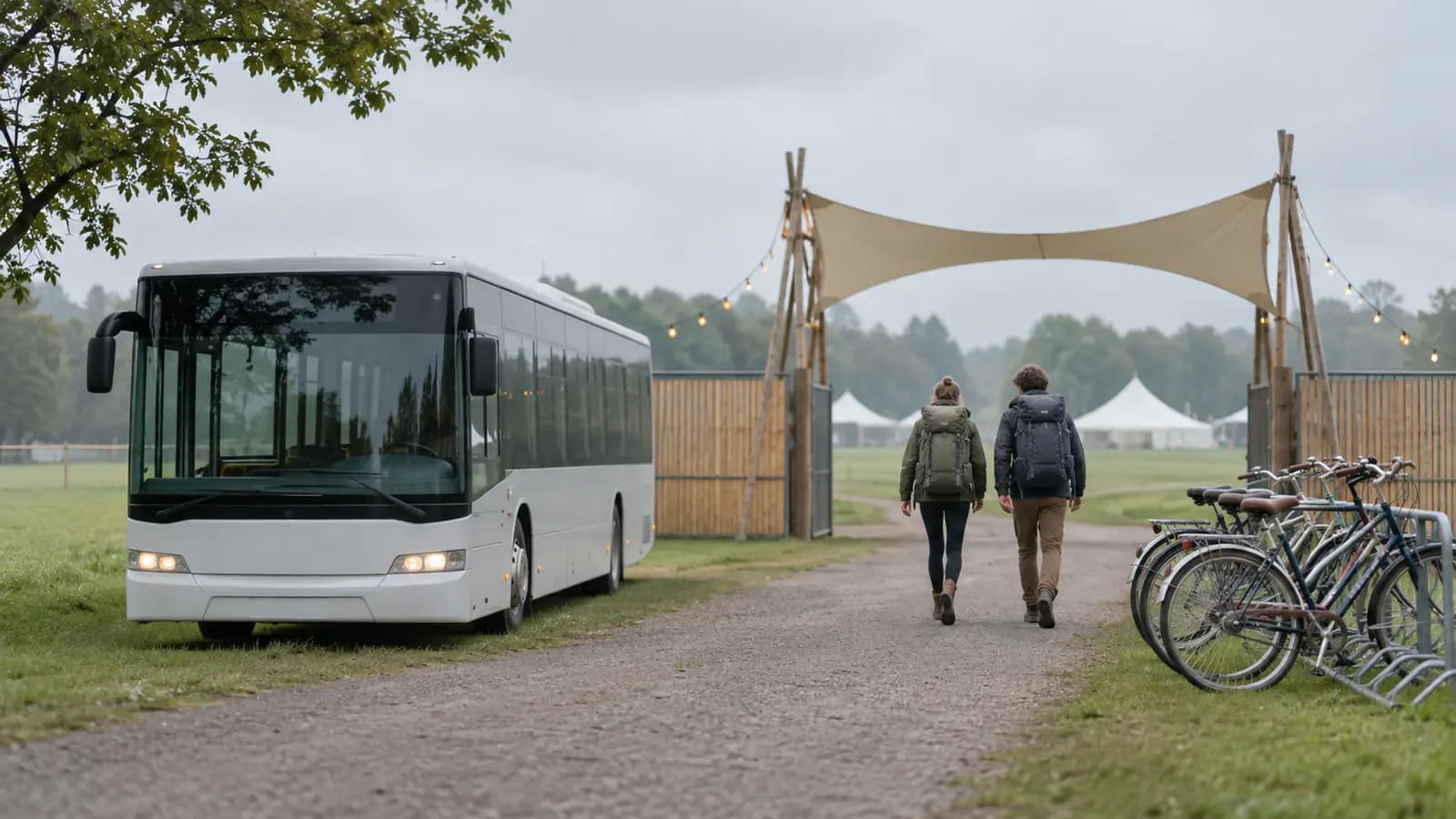
- Public transport: name the nearest stop with a lift and a step-free route, add a map (Pop-Büro). HÖME × NORDEN notes that rail journeys have to be registered and not every station has lifts or raised platforms – say so in your arrival info.
- Parking: marked bays close to the entrance, at least 3.50 m wide, with misuse kept in check (Frankfurt, HÖME × NORDEN). An accessible toilet nearby spares guests the queue after the drive.
- Taxi and shuttle: give the phone number of a wheelchair-accessible taxi (Pop-Büro) and offer a shuttle for guests with disabilities (HÖME × NORDEN).
- The way to the gate: step-free, no thresholds, firm surface, no cobblestones (Frankfurt); a priority lane at the entrance (HÖME × NORDEN).
Ground, paths and platforms: what matters on a field?
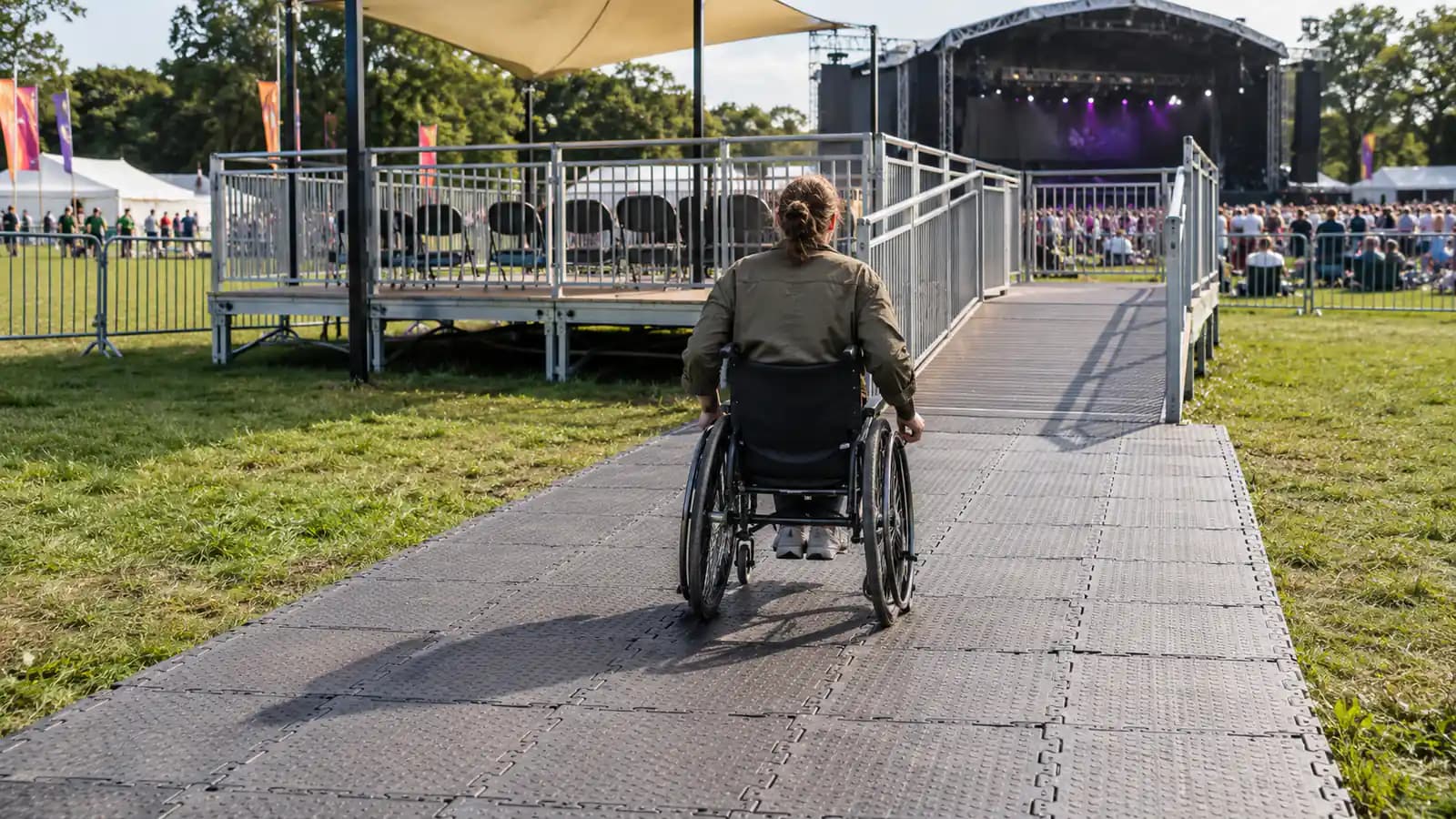
On grass and gravel the ground decides. Temporary track mats only help if width, gradient and joins are right. The values below are rules of thumb from guides, not standards for your site – agree them with the licensing authority and your safety plan (event safety plans).
| Area | Rule of thumb or measure | Source |
|---|---|---|
| Ramps and cable bridges | at most 6 % gradient; at least 120 cm wide in front of stairs; cable bridges with ramps for wheelchairs | Frankfurt, Pop-Büro |
| Thresholds | door thresholds at most 2 cm; outdoors, plates, thresholds and steps matter from 1.2 to 2 cm | Pop-Büro, HÖME × NORDEN |
| Seats | one wheelchair space equals two chairs so the companion sits alongside; raised spots for standing crowds | Pop-Büro |
| Platforms | also for walkers or injured guests; open to others when not taken; free choice of position where possible | HÖME × NORDEN |
| Camping and charging | accessible camping area with sanitary facilities, charging point for electric wheelchairs | HÖME × NORDEN |
| Wayfinding | high-contrast signs (e.g. yellow on black for toilets), pictograms at 130 cm height | Frankfurt, Pop-Büro |
Hurricane Festival shows what this can look like: its outdoor stages have raised viewing platforms and wheelchair-accessible portable toilets, according to the festival.
Draw your site in Alpha Events on a real map (satellite or street), paint paths and ground types and place symbols for entrance, parking, toilets, first aid and accessible; your own graphics and labels cover platforms or quiet areas. A view-only link shares the plan without an account. The plan does not measure gradients or check accessibility – that stays with the site walk.
Toilets: how many, which kind, where?
HÖME × NORDEN says toilets strongly shape whether people come at all and how they feel: visits can take longer, so a few cubicles are a problem when waiting is no option.
- Equipment: wheelchair-accessible, clean and accessible at all times; information on access (Euro key) and opening hours (Frankfurt).
- Avoid standard portable cabins where you can: space, light and hand washing matter (HÖME × NORDEN). Hurricane uses wheelchair-accessible portable toilets at its outdoor stages.
- Several locations: wherever other guests have toilets, plus one close to the car park (HÖME × NORDEN).
- Safety and orientation: alarm button or emergency cord, reflective tape on lid and flush, at least one unisex toilet (Pop-Büro).
Quiet areas, team and assistance dogs: what counts on the day
Quiet area: A retreat in a low-stimulus setting also helps with medical needs and invisible disabilities (HÖME × NORDEN). The Pop-Büro adds seating in several places and areas without strobe lighting, with warning signs where strobes run.
Team: HÖME × NORDEN recommends a trained awareness or mobility team, a service number or WhatsApp group on site and a briefing for security and catering: offer help, but never touch or assist unasked. Staff should know where the accessible toilets are and how to reach the nearest step-free stop (Pop-Büro, HÖME × NORDEN). For the basics, see our article on awareness concepts.
Assistance dogs: Section 12e of the German disability equality act (BGG) bars operators of facilities typically open to the public from refusing access to disabled people because of their assistance dog, unless access would be a disproportionate or unreasonable burden. Whether and how that fits your site is a legal question. The guides list permitted access as a checklist item and mention water for the dog; handlers know best what noise their dog can take, notes HÖME × NORDEN.
In the Alpha Events visitor app you pass on information where guests look anyway: the start page takes your own text and image blocks, and a post marked important sits at the top and goes out as a push notification where the browser supports it. That reaches guests when something changes on the day, such as a closed ramp.
Checklist: what is cheap and what needs lead time?
Start with the rows that cost little. Timing and effort are editorial estimates from planning practice, not a check of your site.
| Task | Settle by | Effort |
|---|---|---|
| Get advice, walk the site with disabled people | 12–9 months before | low |
| Plan paths, ramps, platforms and ground, request materials | 9–6 months before | high |
| Fix accessible toilets and their locations | 9–6 months before | medium to high |
| Request sign language interpreters and hearing aids such as induction loops | 6–4 months before | medium |
| Sort parking, shuttle and a taxi number | 6–3 months before | medium |
| Companion ticket types, access page, contact person, needs question | before presale | low |
| Quiet area, seating and strobe warnings | 3–2 months before | low to medium |
| Emergency: step-free escape routes, visible and tactile alarm | with the safety plan | medium |
| Brief team and security, set rules for assistance dogs | 4–2 weeks before | low |
| Signs, pictograms and notices in the app | 4–2 weeks before | low |
| Walk the site on foot and in a wheelchair before opening | build phase | low |
| Feedback channel and evaluation | after the festival | low |
If a ticket code will not scan at the gate, your team types the 16-character ticket ID into the check-in scanner by hand. After the festival, a short survey with specific accessibility questions pays off; HÖME × NORDEN recommends giving every guest that option. With Alpha Events surveys you add your own questions and share a link. For funding the measures, see our overview of festival funding in Germany.
Put it into practice with Alpha Events
The matching tools – in one platform, free to try.